“But you, Bethlehem Ephrathah, though you are small among the
clans of Judah, out of you will come for me one who will be ruler over
Israel, whose origins are from of old, from ancient times.” Therefore,
Israel will be abandoned until the time when she who is in labor bears
a son, and the rest of his brothers return to join the Israelites.
Micah 5, 1-3
“And behold, you will conceive in your womb and bear a son,
and you will name him Jesus. He will be great and will be called
the Son of the Most High, and the Lord God will give to him the
throne of his ancestor David. He will reign over the house of Jacob forever,
and of his kingdom there will be no end.”
Luke 1, 31-33
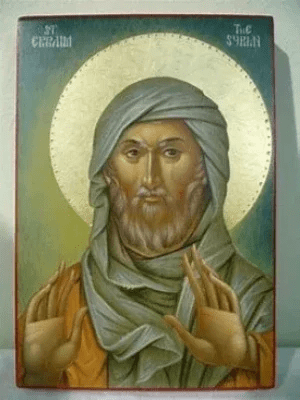
Ephraem of Syria (ante A.D. 373)
Prayer to the Immaculate Queen
“O Virgin most pure, wholly unspotted, O Mary, Mother of God, Queen of the universe,
thou art above all the saints, the hope of the elect and the joy of all the blessed. It is
thou who hast reconciled us with God; thou art the only refuge of sinners and the safe
harbor of those who are shipwrecked; thou art the consolation of the world, the
ransom of captives, the health of the weak, the joy of the afflicted, and the salvation of
all. We have recourse to thee, and we beseech thee to have pity on us. Amen.”
The text attributed to Ephraim of Syria is a beautiful and profound hymn that reflects deep theological and devotional themes centered on the figure of the Virgin Mary.
The text begins by honoring Mary with several exalted titles – “O Virgin most pure,” “wholly unspotted,” and “Mother of God.” These titles emphasize her sinless nature, divine motherhood, and unique role in salvation history. By labeling her as “Queen of the universe,” it underscores her supreme status among all saints and her intercessory power.
The hymn describes Mary as “the hope of the elect” and “the joy of all the blessed.” This indicates that believers find hope and joy through her intercession, suggesting her maternal concern for humanity and her special relationship with God, as she mediated the Incarnation. The line “It is thou who hast reconciled us with God” highlights Mary’s role in the theological understanding of salvation. By bearing Jesus, she plays a key part in humanity’s reconciliation with God, placing her at the heart of the Christian narrative.

The text portrays Mary as “the only refuge of sinners” and “the safe harbor of those who are shipwrecked.” This imagery suggests that individuals in distress can find solace and support in her, a Mother who understands human struggles and intercedes on their behalf. The mention of Mary as “the consolation of the world” and “the ransom of captives” highlights her compassionate nature. She is depicted as someone who brings comfort to the afflicted and liberation to those in bondage. This aspect speaks to her universal role in providing hope and healing.
The concluding petition, “We have recourse to thee, and we beseech thee to have pity on us,” reflects a heartfelt supplication. It acknowledges human vulnerability and the need for divine mercy, emphasizing faith in Mary’s intercession as a source of grace and assistance.
Ultimately, this text encapsulates a rich tapestry of Marian devotion, emphasizing her importance in Christian spirituality as a source of hope, comfort, and aid for those seeking mercy and healing. Through the lens of this hymn, Mary is not only revered for her role in salvation but also cherished as a compassionate maternal figure for all believers.
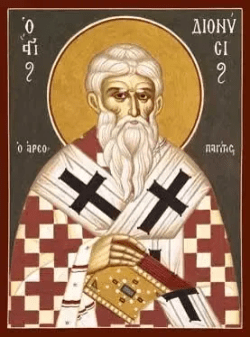
Theoteknos of Livias (ante A.D. 560)
Assumption, 291
“Raised to heaven,
she remains for the human race an unconquerable rampart,
interceding for us before her Son and God.”
Theoteknos of Livias, in his profound reflection on the Virgin Mary, offers us a powerful insight into her role as an advocate and protector within the Christian faith. He declares, “Raised to heaven, she remains an unconquerable rampart, interceding for us before her Son and God.” This striking phrase encapsulates the deep reverence held by believers for Mary’s exalted position, portraying her not merely as a revered figure but as a dynamic intercessor for humanity.
In this context, Theoteknos emphasizes Mary’s status as our Queen Mother, a title that underscores her honor and authority in the heavenly realm. Believers see her as a guardian who provides vigilant care for the faithful. Her intercessory role suggests that she actively pleads for us before her Son, Jesus Christ, and God the Father, bridging the gap between humanity and divinity. This belief is central to Catholic and Orthodox traditions, where Mary is viewed as a compassionate mother who understands our struggles and petitions for divine mercy on our behalf.
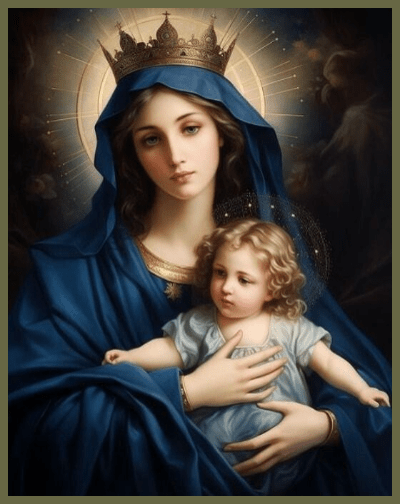
The portrayal of Mary in Theoteknos’ words conveys the essence of her maternal love, illustrating how she nurtures and guides the faithful on their spiritual journeys. As a mediator, she offers not only protection but also comfort and solace, which many believers seek in their prayers. This relationship fosters a sense of closeness to the divine, allowing the faithful to feel supported and encouraged as they navigate life’s challenges.
In essence, Theoteknos captures the profound significance of Mary’s role in the spiritual lives of believers, highlighting the trust and faith they place in her intercessory powers. Her influence is seen as a conduit through which divine grace flows, resonating deeply within the hearts of those who turn to her for support and guidance. Thus, the description serves to inspire devotion and reaffirm the belief in Mary’s active presence in the lives of the faithful.
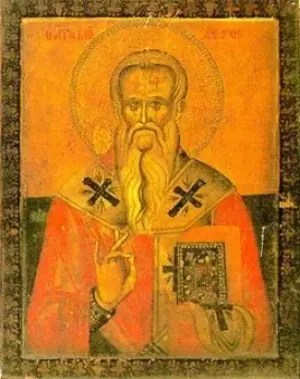
Modestus of Jerusalem (ante A.D. 634)
On the Dormition of the Most Holy Mother of God
“The bright spiritual dawn of the Sun of Justice, [our Lady Mary], has gone to dwell
and shine in His brilliance; she is called there by the one who rose from her, and who
gives light to all things. Through her, that overwhelming radiance pours the rays of His
sunshine upon us, in mercy and compassion, rekindling the souls of the faithful to
imitate, as far as they can, His divine kindness and goodness. For Christ our God, who
put on living and intelligent flesh, which He took from the ever-Virgin and the Holy
Spirit, has called her to Himself and invested her with an incorruptibility touching all
her corporeal frame; He has glorified her beyond all measure of glory, so that she, His
holy Mother, might share His inheritance…“the Queen of mortal man, the most holy
Mother of God.”
St. Modestus, Bishop of Jerusalem, eloquently articulates the profound theological significance of the Virgin Mary within the context of Christ’s incarnation and the overarching divine plan of salvation. This text presents several key themes and concepts that shed light on Mary’s unique role in the Christian faith, inviting believers to consider her impact on their spiritual journeys.
Modestus beautifully begins by referring to Mary as the “bright spiritual dawn” and the “Sun of Justice.” This imagery is rich and evocative, highlighting her role as a radiant source of guidance and illumination for all believers. By likening Mary to a dawn, the text symbolizes the new beginning she represents in the history of salvation. Her purity and holiness stand as a beacon of light, illuminating the path toward Christ and serving as a significant mediator of divine grace. As the “Sun of Justice,” she embodies the moral and ethical clarity that Jesus brings into the world, emphasizing the transformative power of her maternal influence.
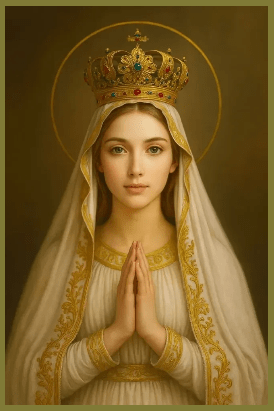
The phrase “who rose from her” underlines Mary’s indispensable role in the incarnation of Christ, emphasizing the significance of her consent and her place in the divine narrative. By affirming that Mary gave birth to Jesus, the text reinforces the belief in her perpetual virginity—a doctrine that highlights her singular status as the Mother of God. This aspect of her identity underscores her entrustment with a sacred mission, one that forms the foundation of the Christian understanding of God becoming man and dwelling among us.
Moreover, the “overwhelming radiance” that emanates from Mary symbolizes not only her own remarkable qualities but also embodies the mercy and compassion of Christ himself. Through her nurturing spirit, believers find inspiration to rekindle their souls and reflect the divine kindness and goodness of Christ in their daily lives. This suggests that, in addition to her being a revered figure, Mary serves as an exemplary model for the faithful, encouraging them to cultivate virtues that resonate with her maternal attributes.
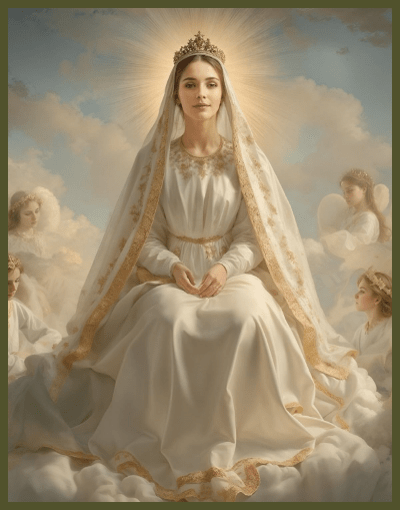
The text further elaborates on the theme of glorification, describing how God honors Mary and invests her with the quality of “incorruptibility.” This praise aligns seamlessly with the doctrine of her assumption into heaven—a belief that signifies her exalted status among the saints and her intimate sharing in Christ’s eternal glory and inheritance. Such recognition elevates Mary not merely to the status of a saint but to that of a powerful intercessor who holds a special place in the hearts of the faithful.
Additionally, Mary is addressed as “the Queen of mortal man” and “the holiest Mother of God,” indicating her elevated position not only in the heavenly realm but also in the spiritual lives of believers. These titles reflect the profound reverence Christians hold for Mary, recognizing her as a model of holiness and a powerful advocate. Her exemplary life and unwavering faith demonstrate the possibilities of human cooperation with God’s grace.
In summary, this excerpt profoundly emphasizes Mary’s pivotal role in the history of salvation, her deep and intimate relationship with Christ, and her lasting influence as a vivid symbol of divine grace. The rich language employed evokes a sense of awe and reverence for Mary as a figure through whom believers can forge a deeper connection with God’s boundless love and mercy, inspiring them to walk in the light of her example.
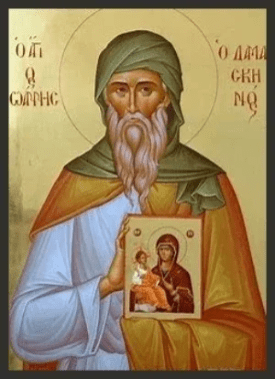
John of Damascus (ante A.D. 749)
An Exposition of the Orthodox Faith, 4:14
“Concerning the holy and much-lauded ever-virgin one, Mary, the Mother of God, we
have said something in the preceding chapters, bringing forward what was most
opportune, viz., that strictly and truly she is and is called the Mother of God. Now let
us fill up the blanks. For she being pre-ordained by the eternal prescient counsel of
God and imaged forth and proclaimed in diverse images and discourses of the
prophets through the Holy Spirit, sprang at the pre-determined time from the root of
David, according to the promises that were made to him. For the Lord has sworn, He
says in truth to David, He will not turn from it: of the fruit of Your body will I set upon
Your throne. And again, Once have I sworn by My holiness, that I will not lie unto
David. His seed shall endure for ever, and His throne as the sun before Me. It shall be
established for ever as the moon, and as a faithful witness in heaven. And Isaiah says:
And there shall come out a rod out of the stem of Jesse and a branch shall grow out of
his roots… “Must there not therefore be a Mother of God who bore God incarnate
Assuredly she who played the part of the Creator’s servant and mother is in all
strictness and truth in reality God’s Mother and Lady and Queen over all created
things.”
The text is a passage attributed to John Damascene, a prominent theologian and defender of the Christian faith in the early Byzantine period. In this excerpt, he elaborates on the significance of Mary, the Mother of God, emphasizing her unique role in salvation history.
The passage opens by affirming that Mary is both strictly and truly called the Mother of God (Theotokos). This title acknowledges her divine maternity, as she gave birth to Jesus Christ, who is fully God and fully man. This affirmation is crucial in establishing Mary’s importance in the Christian faith. John Damascene highlights that God’s eternal plan foreordained Mary’s role. He suggests that her existence was part of a divine plan set in motion long before her birth, illustrating the idea of predestination in Christianity.
The author references various biblical prophecies, with a particular focus on promises made to King David regarding a ruler from his lineage. The connection to Jesus emphasizes that Mary’s maternal role fulfills these prophecies. By being of the “root of David,” she is positioned as the link between the Old Testament promises and their New Testament fulfillment in Christ. The text cites specific biblical verses (Psalms and Isaiah) that assure the perpetuity of David’s lineage and the coming of the Messiah.
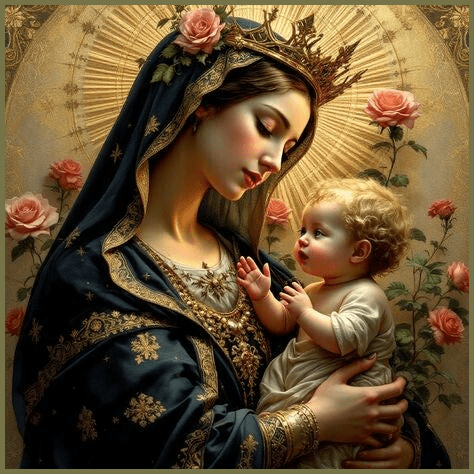
John Damascene underscores God’s unbreakable promise, indicating that Mary embodies it as the vessel through which God incarnated. He notes that Mary’s significance is not merely in her motherhood but also in her role as the servant of the Creator. This dual identity as mother and servant reinforces her exalted status as a “Lady and Queen” over all creation, a theme often found in Marian doctrine.
By concluding that there must, therefore, be a Mother of God, he stresses the necessity of Mary in God’s salvific plan, thus elevating her status in the Christian tradition. The reflection embodies both respect and theological depth regarding her role in the mystery of the Incarnation. Overall, the passage reinforces Mary’s pivotal role in Christian theology, portraying her as a bridge between the Old and New Testaments, an essential figure in God’s redemptive plan.
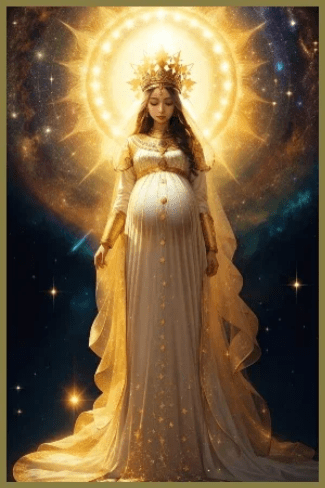
A great sign appeared in heaven: a woman clothed with the sun,
with the moon under her feet and a crown of twelve stars on her head.
She was pregnant and cried out in pain as she was about to give birth…
The dragon stood in front of the woman who was about to give birth
so that it might devour her child the moment he was born. She gave birth
to a son, a male child, who “will rule all the nations with an iron scepter.”
And her child was snatched up to God and to his throne.
Revelation 12, 1-5

SALVE REGINA
 Marian Catholic
Leave a comment